
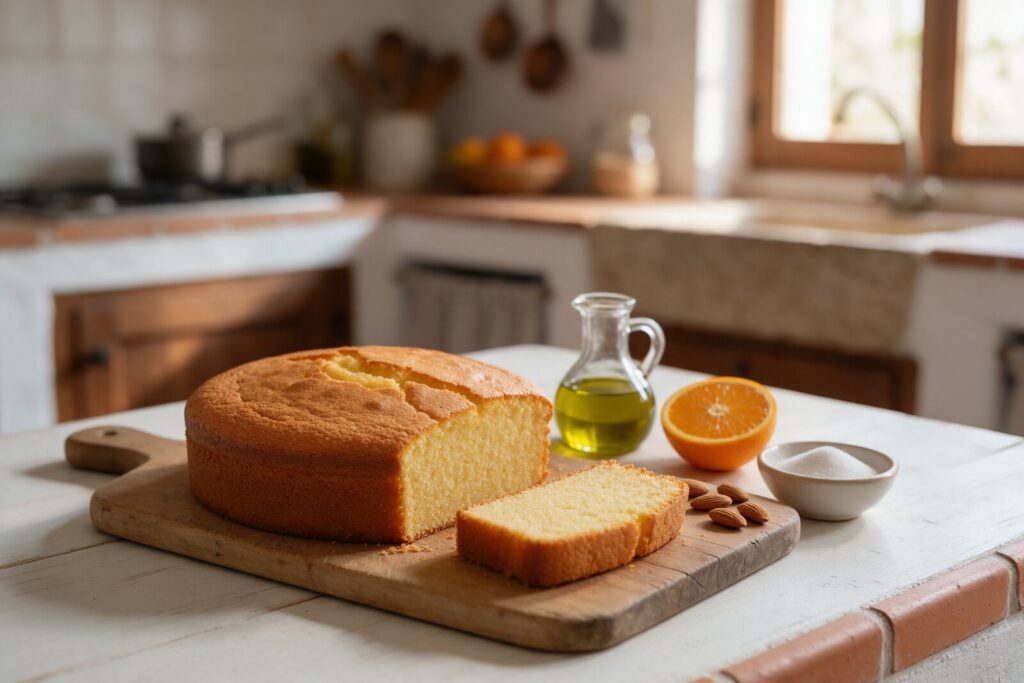
Yes, you can bake a cake with extra virgin olive oil, and a good olive oil cake is one of the simplest bakes there is: no softening butter, no creaming, just a bowl and a whisk. The crumb comes out moister and stays soft for days. What you do need to think about is flavour, because a strong oil like ours does not disappear in the oven. Below is the cake we make at home, then why it works and what to pair it with.
Our olive oil cake recipe
This is a plain, reliable olive oil cake: lightly citrus, with a little ground almond for body.
Ingredients (20 cm round tin)
- 3 large eggs, at room temperature
- 200 g caster sugar
- Finely grated zest of 1 orange and 1 lemon
- 150 g extra virgin olive oil (about 165 ml), plus a little for the tin
- 150 ml whole milk
- 200 g plain flour
- 50 g ground almonds
- 2 tsp baking powder
- A good pinch of fine salt
- Icing sugar, to finish (optional)
Method
- Heat the oven to 180 °C (160 °C fan, gas 4). Oil a 20 cm round tin, at least 6 cm deep, and line the base with baking paper.
- Rub the zest into the sugar with your fingertips until it smells strongly of citrus. Add the eggs and whisk with an electric mixer for 3 to 4 minutes, until pale, thick and roughly doubled.
- With the mixer running, pour in the olive oil in a slow, steady stream, then the milk. The batter will be thin; that is right.
- Mix the flour, ground almonds, baking powder and salt in another bowl, then fold them in with a spatula until no dry flour remains. Do not beat it.
- Pour into the tin and bake for 40 to 45 minutes, until golden, risen and springy, and a skewer comes out clean from the centre. Start checking at 35 minutes.
- Cool in the tin for 15 minutes, then turn out onto a rack. Brush the top with a teaspoon of olive oil while still warm, and dust with icing sugar once cold.
Using a 23 cm tin? Keep the quantities the same; the cake will be shallower, so check from 30 minutes and expect 35 to 40. Wrapped and kept at room temperature, it stays moist for three to four days. The oven is at 180 °C, but the inside of the cake never gets much above 100 °C, so the oil is not under stress; we go into temperatures in our piece on cooking with extra virgin olive oil.
What oil does in a cake that butter doesn’t
Butter is around four-fifths fat and up to a sixth water, and it sets firm as it cools. Oil is all fat and stays liquid at room temperature. That one difference explains most of what you notice in an oil-based cake:
- Moister crumb. The fat coats the flour and stays fluid, so the cake stays soft for days at room temperature.
- Keeps longer. An olive oil cake is often better on day two than day one, and still good on day four, while a butter sponge tends to dry out and firm up.
- No creaming. With butter you beat air into the fat. With oil the air comes from whisking eggs and sugar, and the oil is simply streamed in.
- Less rich, more tender crumb. You lose the dairy flavour of butter and gain whatever the oil brings, which is the interesting part.
What a peppery Picual does in a cake
Most olive oil cake recipes assume a mild oil, and many tell you to use one so the cake does not taste of olives. We take the other view. Our oil is 100% Picual from a single grove in the Sierra Mágina in Jaén, at over 900 metres, picked green in October and November and cold milled the same day, below 27 °C. Green, early-harvest Picual is grassy, bitter and peppery, the kind that catches at the back of the throat. (There is more on what Picual tastes like in its own article.)
In a cake, some of that sharpness softens with the heat and the sugar, but the character carries through. You get a green, almost herbal note behind the sweetness and a faint pepper on the finish. The bitterness and pungency come from polyphenols, which green fruit carries more of. With sugar and citrus around them they read as depth rather than harshness, the way a pinch of salt does in caramel. So do not try to hide a strong oil. Give it flavours that can stand next to it.
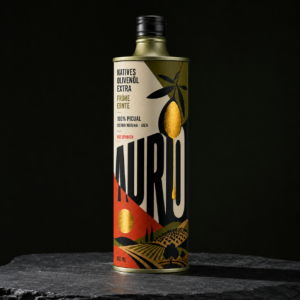
La Lata · 500 ml
Our early-harvest Picual from a single grove in the Sierra Mágina, picked green and milled the same day. It comes in a tin because light is the enemy of good oil, and the tin keeps it out completely.
What to pair it with
Pair a peppery oil with things that are sharp, nutty or bitter in their own right. These work well in the recipe above:
- Citrus: orange, lemon, blood orange or clementine zest, and a squeeze of juice in a simple drizzle.
- Almond: swap up to 100 g of the flour for ground almonds for a denser, moister cake.
- Chocolate: replace 40 g of flour with cocoa powder and drop the citrus, or fold in 100 g of chopped dark chocolate.
- Sharper fruit: rhubarb, plums, blackberries or raspberries scattered over the top before baking.
- Herbs: a teaspoon of finely chopped rosemary with the lemon zest is very good with this oil.
Be more careful with delicate flavours such as plain vanilla or a light Victoria-style sponge. There the oil can dominate, and butter or a milder oil may suit you better.
Swapping butter for oil in your own recipes
You can turn many butter cakes into oil cakes, but not gram for gram. Butter is not pure fat, so 100 g of butter brings roughly 80 g of fat and a bit of water. Replacing it with 100 g of oil means more fat than the recipe was designed for, and a heavy, greasy cake.
| Per 100 g | Fat | Water |
|---|---|---|
| Butter (EU legal standard) | at least 80 g, under 90 g | up to 16 g |
| Olive oil (standard nutrition declaration) | about 100 g | practically none |
Our rule of thumb follows from those figures: use about three-quarters of the butter weight in oil, so 75 to 80 g of olive oil for every 100 g of butter, and add a splash of milk if the batter looks stiff. Whisk the eggs and sugar well first, since you no longer get air from creaming. Recipes that rely on solid butter, such as shortbread, laminated pastry or buttercream, do not convert; stick to sponges, loaf cakes, muffins and quick breads.
Choosing an olive oil for baking
Use extra virgin. A cheap, flat oil adds fat without flavour, and the whole point of this cake is the taste of the oil. Pick it the way you would for dressing a salad: taste a little on its own and ask whether you would enjoy that flavour behind sugar and lemon.
Use it fresh, too. Like any oil, olive oil does go off once open, and a stale one tastes waxy or of old nuts, which a cake will not hide. Keep it away from light and heat, and close the lid between uses.