
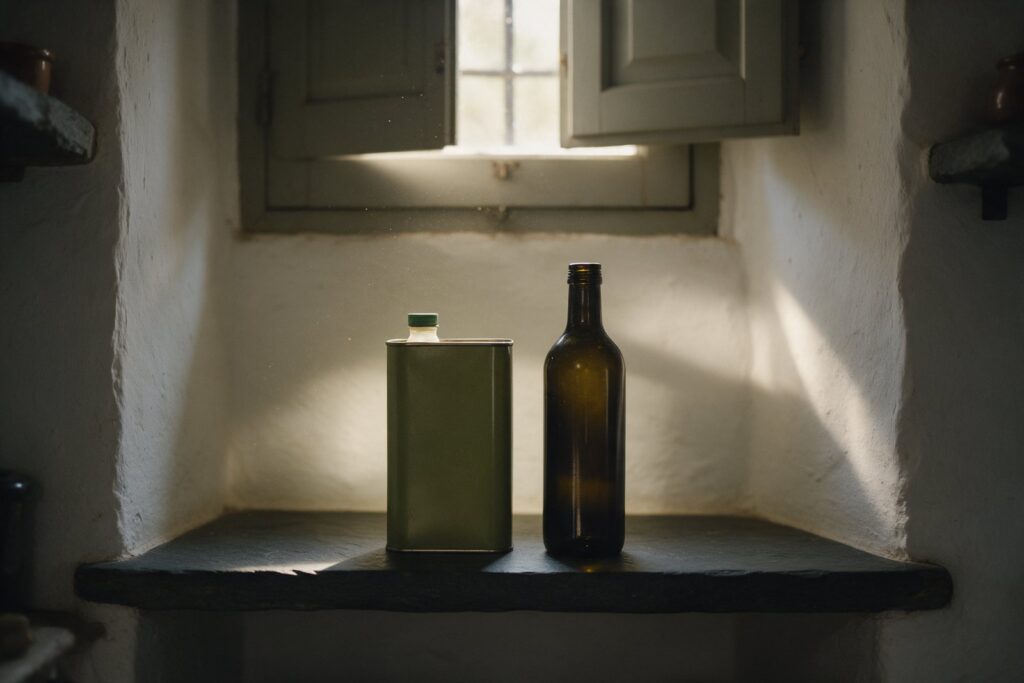
You find a bottle at the back of a cupboard, half full, with a date on the label that passed three months ago. Do you pour it away?
Probably not — and probably not for the reason you think. Does olive oil go off? Not in the way milk does. It does not expire; it degrades. The difference matters, because it changes how you judge the bottle in front of you.
The date on the bottle is a best-before, not an expiry date
A typical best-before on bottled olive oil is 18 to 24 months from bottling. That date is the producer’s estimate of how long the oil will still be what it claims to be — extra virgin, with its aroma and its flavour intact — under reasonable storage. It is not a cliff edge. Nothing happens to the oil at midnight.
Two bottles with the same best-before can be in completely different condition. One was pressed in November and kept in a dark cupboard. The other was pressed the previous season, sat in a shop window for a summer, and was bottled late. The label says the same thing. The oil does not.
This is why we argue for the harvest date rather than the bottling date. Harvest tells you when the fruit became oil; bottling only tells you when someone filled a container. We explain what that means in practice in our guide to early harvest olive oil.
So does olive oil go off?
Yes, eventually — but not on a date, and not all at once. Extra virgin olive oil fades long before it turns: the green, peppery aromatics thin out over months, and only later does the oil become properly rancid. There is no visual test and no number on the label that will tell you where yours is. The only reliable test is your nose. With a bottle you have had open for more than a couple of months, or any bottle more than a year past harvest, start checking before you pour.
Does olive oil go bad at a predictable rate? No — age alone tells you very little. A six-month-old bottle that has been treated badly can be flatter than a two-year-old bottle that has been treated well.
How long does olive oil last?
Two figures are worth holding on to. Unopened, stored cool and dark, treat the 18 to 24 months on the label as realistic — an oil in a sealed, light-proof container stays close to itself for most of that window, and the earlier part of it is where the oil is at its best. Once opened, aim to finish it within a couple of months. Air is now the problem, and it does not stop working between uses.
One number you will see quoted does not help you here. Extra virgin has a legal ceiling of 0.8% free acidity, and it is a genuinely useful figure — but it is a measure of how the fruit was handled, not a clock running in your kitchen. Free acidity is set at the mill, by the condition of the olives, how bruised they were, how long they waited before milling and how the oil was extracted. In a sealed container at home it barely moves. An oil that has gone rancid in your cupboard is almost always still comfortably under 0.8%; what has changed is the smell and the taste. Grade is lost in storage by sensory defect, not by acidity creeping up.
Which is the whole argument for the harvest date, and for your own nose.
What actually makes olive oil go off
Four things do the damage, and they work together rather than in any neat order. Oxygen gets in every time you open the container, and a half-empty bottle has a column of air sitting on the oil. Light, particularly UV, breaks down aroma compounds and polyphenols — which is why clear glass on a sunny worktop is the cruellest thing you can do to a good oil. Heat speeds every one of those reactions up, so the shelf above the hob is the wrong shelf. And time since pressing runs regardless: even in a sealed tin in the dark, the oil is on a one-way trip from the day it leaves the mill.
The practical upshot is short: cupboard, not worktop; away from the hob; closed properly; and a size you will actually finish. The fridge is not the answer either — cold does slow oxidation, but a bottle going in and out picks up condensation, and the oil clouds and pours badly. We go through storage properly, including why we pack in tin rather than glass, in Tin vs Bottle: The Best Way to Store Extra Virgin Olive Oil.
What rancid smells and tastes like
This is the part worth learning, because once you know it you never need the label again. Pour a little into a glass, cup your hand over the top, warm it for a few seconds in your palm, then smell.
Rancid oil smells of:
- Old walnuts, or the inside of a nut shell left too long
- Wax crayons, or putty
- Stale biscuits, or a chip pan that needed emptying last week
- Plasticine, cardboard, old paint
On the palate it is flat and slightly greasy, with a dull, lingering aftertaste that coats your mouth and does not go away. There is no lift to it. If you have ever eaten a stale walnut, you already know the flavour.
A useful trick: compare. Open a fresh bottle next to the suspect one. Rancidity is hard to name in isolation and obvious side by side.
Bitter and peppery is not the same as gone off
People throw away perfectly good oil because it stings. A fresh Picual is bitter at the sides of the tongue and catches at the back of the throat — sometimes hard enough to make you cough. That is not a fault. It is the taste of polyphenols, and it is strongest when the oil is young. We describe it properly in The Taste of Picual.
Rancid is the opposite of young. It is soft, flat, nutty in a tired way, and it has no edge at all.
Cloudiness, or a few solid white flecks after a cold night, is not a fault either. That is the oil partially setting in the cold. Bring it back to room temperature and it clears.
What to do if your olive oil has gone off
First, the question most people are really asking: rancid oil is a quality problem rather than a safety one. What it ruins is the food you put it on.
Do not cook with it hoping the heat will hide the flavour — heat makes rancidity more obvious, not less, and it carries straight into the food.
To get rid of it: never down the sink, where it sets and blocks drains. Let it cool if it has been used, pour it into a sealed container and put it in with the general waste, or take any quantity worth the trip to your council’s cooking-oil recycling point.
The best defence is an oil that starts fresh and is packed so it stays that way. Ours comes from a single grove in Sierra Mágina, Jaén, at over 900 m; the Picual is picked green in the first weeks of the campaign, reaches the mill in under 24 hours and is cold-extracted below 27 °C. We pack it in tin because light never gets through, and we sell direct, so there are fewer months between the mill and your kitchen. If you want a reference point for what fresh actually smells like, start with our 500 ml tin.