
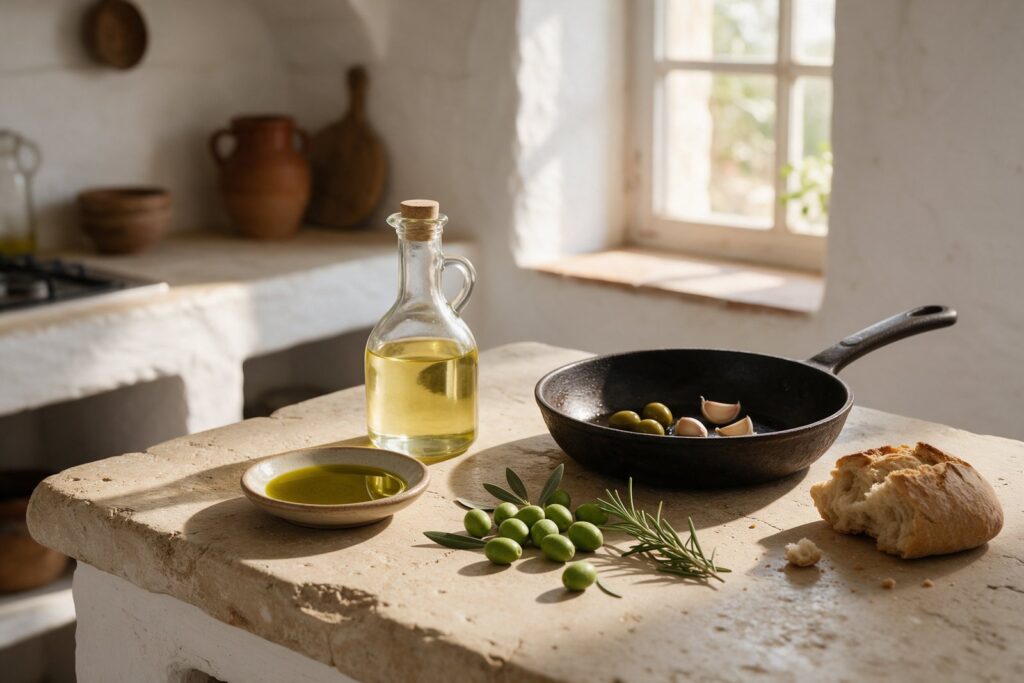
Rapeseed oil vs olive oil is the comparison most British kitchens actually face: one is the bottle that does the everyday frying, the other the one people feel they ought to be using more. We make extra virgin olive oil, so we are not neutral. But a comparison in which our oil wins on every count would be an advert, and it would not help you decide. Rapeseed oil wins on several points, and we say so below. Sunflower and the bottle simply labelled “vegetable oil” get a section too.
Rapeseed oil vs olive oil: the short answer
They are not substitutes for each other so much as tools for different jobs. Refined rapeseed oil is cheap, neutral in taste and perfectly good for high-volume frying and baking. Extra virgin olive oil costs several times as much per litre, tastes strongly of the fruit and earns that price where you can taste it: raw, on finished food, and in everyday pan cooking where a spoonful or two is all you use. Most kitchens are well served by having one of each.
There is also a difference in how they are made. Most supermarket rapeseed oil is solvent-extracted and refined; extra virgin olive oil is separated from the fruit by mechanical means only and sold unrefined. We go through that in is olive oil a seed oil?, so we will not repeat it here. One thing worth knowing, though: cold-pressed rapeseed oil, the golden kind from British farms, is pressed mechanically and not refined either. On process, it sits much closer to virgin olive oil than to the clear bottle beside it.
Fat profile: where rapeseed and olive oil differ
Olive oil is mostly oleic acid, a monounsaturated fat. Low-erucic rapeseed oil, which is what is sold for cooking, also has a lot of oleic acid, more linoleic acid than olive oil, and clearly more alpha-linolenic acid (the linolenic acid in the chart). That last point is a plain compositional difference, and on it rapeseed is well ahead of both olive and sunflower oil. Conventional sunflower oil is the odd one out: mostly linoleic acid, with comparatively little oleic.
Ranges as % of total fatty acids. Oleic acid: olive oil 55.0–83.0; rapeseed oil (low erucic) 51.0–70.0; sunflowerseed oil 14.0–39.4. Linoleic acid: olive oil 2.5–21.0; rapeseed oil 15.0–30.0; sunflowerseed oil 48.3–74.0. Linolenic acid: olive oil ≤ 1.0; rapeseed oil 5.0–14.0; sunflowerseed oil ND–0.3. Sources: olive oil, Reg. (EEC) 2568/91, Annex I; seed oils, Codex Standard for Named Vegetable Oils, CXS 210-1999, Table 1.
Two things follow from those ranges, neither of them a verdict. First, on oleic acid, olive and rapeseed overlap more than people expect. Second, the double bonds in linoleic and linolenic acid are where oxidation starts, so an oil with more of them tends to go stale or rancid sooner once it is opened and warm, and breaks down faster under prolonged heat. That is a point about keeping and cooking, not about what the oil does for you. And high-oleic sunflower oil, bred for frying, falls well outside the conventional range shown here.
Smoke point and frying
Published smoke-point ranges for a fresh extra virgin olive oil generally land around 190–210 °C, and refined olive oil is quoted higher, roughly 220–240 °C. Refined seed oils, rapeseed included, are usually quoted above extra virgin. These are general industry ranges from lab tests, not measurements of our oil, and they say less than people think: home pan-frying runs at roughly 160–180 °C and deep-frying at 170–180 °C, below every one of those ranges.
So both oils can fry. The real question is what you lose. Heat drives off the aroma of an extra virgin olive oil long before it gets near smoking, and that aroma is most of what you paid for. Refined rapeseed oil has no aroma to lose. For a deep-fat fryer, a batch of chips or anything held hot for a long time, that makes refined rapeseed the sensible choice. The full numbers are in can you cook with extra virgin olive oil?
Flavour: neutral, nutty or green
This is where the two are least alike. Refined rapeseed oil tastes of almost nothing, which is exactly why bakers use it: a sponge or a batch of muffins should taste of butter, eggs and vanilla, not of oil. Cold-pressed rapeseed oil is different again, with a nutty, grassy, slightly brassica flavour that some cooks love on roast potatoes and others find dominant.
A green, early-harvest olive oil is the most assertive of the lot. Our Picual is bitter and peppery, with notes of cut grass and green tomato, because the olives are picked green and milled the same day. That is a strength on a salad, over beans, on grilled fish or bread, and a weakness in a lemon drizzle cake. If you want an oil you will not notice, olive oil is the wrong choice, and we would rather say so than sell you a tin for a job it is bad at.
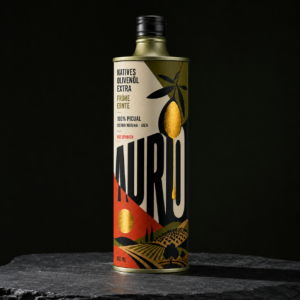
The tin · 500 ml
100 % Picual from a single grove in the Sierra Mágina, Jaén, at over 900 metres. Picked green in October and November, cold milled the same day below 27 °C, and packed in a 500 ml tin that blocks light completely. An oil for finishing and everyday cooking, not for the deep-fat fryer.
Cost per use
A litre of good extra virgin olive oil costs several times what a litre of refined rapeseed or sunflower oil does. Where that matters is volume. Filling a deep-fat fryer, roasting trays of potatoes every week or baking in quantity uses a lot of oil, and most of its flavour disappears in the process. Paying the olive oil premium there buys you very little.
Where it hardly matters is the spoonful. A thread of oil over soup, a dressing for two, a slick in the pan for eggs: you use a small amount, you taste all of it, and the difference in cost per serving is small next to the rest of the plate. That is the honest economics. We set out how we split the two in how to use extra virgin olive oil.
Sunflower and generic vegetable oil
Conventional sunflower oil is the cheapest common frying oil and, like refined rapeseed, neutral in flavour. Its fat profile is the one that differs most from olive oil, being mostly linoleic acid. High-oleic sunflower oil, now common in commercial frying, is bred to be much closer to olive oil on oleic acid, which makes it more stable in the fryer. If you see it on a label, it is a reasonable choice for heat.
“Vegetable oil” on a British supermarket shelf tells you less. It is often pure rapeseed oil, sometimes a blend of seed oils, and the ingredient list is the only place to find out which. Treat it as you would refined rapeseed: a cheap, neutral oil for frying and baking, and nothing more.
Which oil for what
- Deep-frying, large batches, frying several times a week: refined rapeseed, high-oleic sunflower or a generic vegetable oil. Cheap and neutral; olive oil gains you nothing you can taste here.
- Baking where oil should be invisible: refined rapeseed or sunflower.
- Roast potatoes and vegetables: either. Cold-pressed rapeseed if you like its nutty taste, olive oil if you want the fruit.
- Everyday pan cooking, eggs, a sofrito, sautéed greens: extra virgin olive oil works well and you use little of it.
- Dressings, finishing, bread, anything raw: extra virgin olive oil. This is where its flavour is the point and where no seed oil replaces it.
- If the higher alpha-linolenic content matters to you: rapeseed has more of it than olive oil, and that is simply what the composition says.
We cook with both in our own kitchen: an inexpensive oil for the fryer and our own oil for everything we want to taste. Rapeseed oil vs olive oil is not a contest one side has to lose. Buy the cheap oil for volume and the good one for flavour, and keep the good one cool and out of the light.