
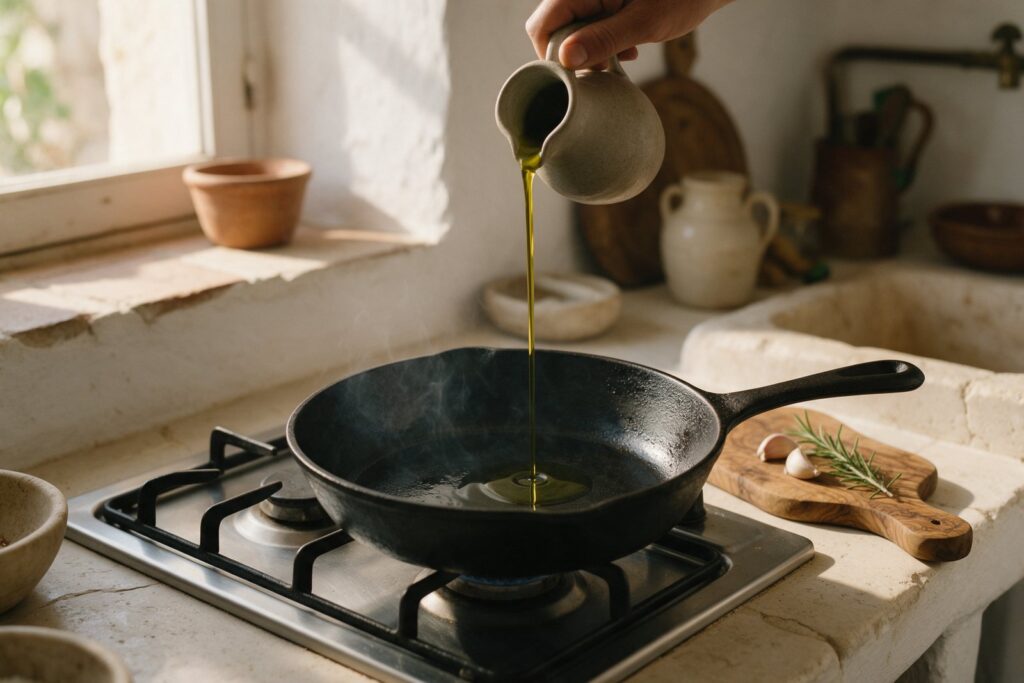
Put a probe thermometer into a pan of shallow-frying oil and you will read 160–180 °C (320–356 °F). Published smoke-point ranges for a decent extra virgin olive oil start above that. That gap is why the standard advice — never cook with the good stuff — falls apart. So: can you cook with extra virgin olive oil? Yes. Here are the numbers, what heat costs you, and when we reach for something cheaper.
What the smoke point of extra virgin olive oil actually is
Smoke point is the temperature at which an oil begins giving off continuous bluish smoke in a standardised test. For a fresh, well-made extra virgin, published ranges generally land around 190–210 °C (374–410 °F). Refined olive oil — the same fruit, stripped of its free fatty acids and most of its flavour — is quoted higher, roughly 220–240 °C (428–464 °F) — which is where the habit of keeping a refined oil by the hob comes from. Both are general industry ranges from lab tests, not measurements of our oil.
Why the number moves: free acidity and polyphenols
What smokes first is not the triglyceride — the fat molecule itself — but the light material suspended in it: free fatty acids, mono- and diglycerides, water, particles of olive flesh. Free fatty acids volatilise well below the temperature at which the fat breaks down, so the more of them an oil carries, the lower its smoke point sits. Under EU rules an oil may only be sold as extra virgin if its free acidity is at most 0.8% expressed as oleic acid, and quality mills aim far below that ceiling. Lampante oils run much higher and smoke earlier.
Polyphenols pull the same way, less directly: they do not lift the smoke point much on their own, but they slow the oxidation chain that generates new free fatty acids in the pan, so a polyphenol-rich oil holds its number longer. Sediment in an unfiltered oil scorches earlier still.
Domestic cooking temperatures, against those figures
- Anything wet tops out near 100 °C (212 °F). A braise, a sofrito, vegetables sweating in their own moisture: while there is water in the pan, the contents cannot climb far above boiling point.
- Sweating and sautéing: roughly 120–160 °C (248–320 °F).
- Pan-frying and shallow-frying: roughly 160–180 °C (320–356 °F).
- Deep-frying: 170–180 °C (338–356 °F) is the standard window, and sound practice rarely pushes past 190 °C (374 °F). Hotter, and food colours before it cooks through.
- Roasting: oven air at 200–220 °C (392–428 °F), but oil in a tray in contact with wet food stays well below the air temperature for most of the time.
Against 190–210 °C, every ordinary domestic method sits inside the range, with dry high-temperature roasting the one case that can approach it late in the cook. So can you use extra virgin olive oil for cooking? For nearly everything you do at home, yes. And can you fry with olive oil? Spain has done it as the default for generations, extra virgin included.
Stability under heat is not the same thing as smoke point
Smoke point tells you when an oil starts making visible smoke. Oxidative stability tells you how fast its fats degrade into off-flavoured compounds while hot. Different properties, and they do not rank oils in the same order.
Several seed oils smoke later than extra virgin olive oil and degrade faster, because oxidation is driven by fatty-acid profile and antioxidant content, not by smoke point. Trade standards allow olive oil an oleic acid content of 55–83%, and Picual sits characteristically at the upper end. Oleic acid is monounsaturated — one double bond per molecule, and the double bond is where oxidation attacks. A largely polyunsaturated fat carries two or three such sites per molecule and breaks down faster. Add the polyphenols and tocopherols of an unrefined oil and you have a fat that takes heat better than its smoke point suggests.
What degrades first when you heat it
- Aroma goes first. The volatiles behind a fresh Picual’s cut grass and green almond are, by definition, volatile: they start leaving from around 100 °C (212 °F) and are largely gone before the oil is hot enough to fry in. That is the real price of cooking with an early-harvest oil, and it is a flavour cost.
- Polyphenols go next. They fall away with both temperature and time — a brief sauté takes a modest toll, twenty minutes at frying temperature a much larger one. Frying trials show substantial reduction rather than total loss, though the figure depends on oil, temperature and duration.
- The fat itself goes last. Triglyceride breakdown — polar compounds, oxidised triglycerides, new free fatty acids — is what actually spoils an oil, and for a high-oleic, polyphenol-rich oil it is the slowest of the three.
Cooking with it does not ruin it, but it does flatten it. If you paid for the aroma, cook in the oil and add a raw thread at the end, off the heat — the split we work through in how to use extra virgin olive oil.
An oil that is smoking and an oil that is degraded
Smoke means the light fraction at the surface has hit its volatilising temperature; take the pan off the heat and it stops. A pan that smoked for a few seconds has not produced something you need to throw out.
Degradation is cumulative and does not reverse. Oil held hot for a long stretch, run through several frying sessions, or topped up with fresh poured into old accumulates polar compounds and free fatty acids. You can read it: it darkens, thickens, foams at the edge, smells acrid rather than nutty, and smokes earlier than when new. That early smoking is a symptom of degradation, not its cause. The same chemistry runs slowly in a cupboard — see does olive oil go off.
So can you cook with extra virgin olive oil? What we do
- Heat the pan first, then add the oil. Oil alone in a dry pan over a high flame overshoots fast.
- Buy a probe thermometer. It settles the argument — most people cook cooler than they assume.
- Hold deep-frying at 170–180 °C (338–356 °F), and do not chase a hotter pan to save time.
- Do not let it smoke — not because smoke is a disaster, but because the pan has gone past where you wanted it.
- Never top up hot oil with fresh. You are contaminating the new oil, not rescuing the old.
- Reusing frying oil: cool it, filter it, keep it dark, and use it a handful of times at most.
- Finish off the heat. The raw drizzle is where an early-harvest oil earns its price.
When a cheaper oil genuinely is the right call
Plainly, because the opposite gets sold too hard: if you deep-fry three litres at a time, or fry in volume several times a week, a refined olive oil or an inexpensive neutral oil is the sensible choice. Not because extra virgin cannot take the heat — it can — but because you will drive off the aroma and polyphenols you paid a premium for. Most kitchens are better off with two oils: an ordinary one for heat and volume, and one good oil used deliberately. That is how it works in most houses in Jaén, ours included.
The oil we are talking about
AURO is 100% Picual from a single grove in the Sierra Mágina, Jaén, at over 900 metres. We pick early, across October and November, while the fruit is still green, and mill the same day. Extraction is cold, below 27 °C — which is what “cold extraction” is legally permitted to mean under Reg. (EU) 29/2012 Art. 5: oil obtained below 27 °C by percolation or centrifugation. First cold pressing is the separate, older case of a hydraulic press. The full sequence is in how olive oil is made. It comes in a 500 ml tin, because light destroys this kind of oil and a tin blocks it completely. See the Picual tin.