
Does olive oil have omega-3? Barely. Olive oil is mostly oleic acid, a monounsaturated fat, and the omega-3 it carries is capped by law at 1% of its fatty acids. That small number is not a flaw we need to explain away. It is the reason olive oil behaves the way it does in a hot pan and on a shelf. Below: what the omega labels mean, what the official figures say, and where the omega-3 in cooking oils actually is.
Does olive oil have omega-3? The short answer
A little, and only one kind. The omega-3 that occurs in plant oils is alpha-linolenic acid, usually shortened to ALA and written C18:3. EU rules set the limit for every olive oil category at no more than 1.0% of total fatty acids (Reg. (EEC) No 2568/91, Annex I). An oil above that line does not count as olive oil, whatever the bottle says.
The other omega-3s people have in mind when they talk about fish, EPA and DHA, are not in olive oil at all. They are not in any plant oil.
So the honest answer is: a trace of ALA, no EPA or DHA, and a great deal of something else.
What omega-3, omega-6 and omega-9 actually mean
The omega number is a piece of chemistry, not a grade. A fatty acid is a chain of carbon atoms with an acid group at one end. The far end of the chain is called the omega end. Count from there to the first double bond between two carbons, and that position gives you the omega number.
- Omega-3: the first double bond sits three carbons from the omega end. In plant oils this is alpha-linolenic acid, C18:3, meaning 18 carbons and three double bonds.
- Omega-6: the first double bond is at carbon six. The main one in kitchen oils is linoleic acid, C18:2, with 18 carbons and two double bonds.
- Omega-9: the first double bond is at carbon nine. This is oleic acid, C18:1, with 18 carbons and a single double bond.
All three are the same length. What separates them is how many double bonds they carry and where the first one sits. In the kitchen, that count matters far more than the label, as we will come to.
A word on omega-9, because it turns up on bottles as if it were a selling point. Omega-9 is simply oleic acid under another name. Every olive oil is mostly made of it, several other oils contain a lot of it too, and printing it on a label tells you nothing the word “olive” had not already told you.
How olive oil compares with rapeseed and sunflower
The legal composition ranges make the differences plain. Olive oil sits at the oleic end, conventional sunflower oil at the linoleic end, and rapeseed oil (sold as canola in North America) in between, with the most ALA of the three.
Ranges in % of total fatty acids. Olive oil: oleic 55.0–83.0, linoleic 2.5–21.0, linolenic ≤1.0 (Reg. (EEC) No 2568/91, Annex I). Rapeseed oil, low erucic acid: oleic 51.0–70.0, linoleic 15.0–30.0, linolenic 5.0–14.0. Sunflower oil: oleic 14.0–39.4, linoleic 48.3–74.0, linolenic ND–0.3 (Codex Alimentarius CXS 210-1999, Table 1). ND = not detectable. These are legal and standard ranges, not an analysis of our oil.
Two things stand out. First, the ranges are wide: an olive oil can legally have anywhere from 55% to 83% oleic acid, depending on cultivar, climate and how ripe the fruit was. Second, the linolenic bars for olive and sunflower are barely visible, while rapeseed’s is clearly longer. We set the two main oils side by side in our rapeseed oil vs olive oil comparison; the point here is narrower. On omega-3 there is a real gap, and it runs in rapeseed’s favour.
Why fewer double bonds make a steadier oil
Each double bond is a weak point where oxygen can attack the chain. A fatty acid with one double bond reacts slowly. One with two reacts faster, and one with three faster still.
In the pan, an oil made mostly of oleic acid holds up to heat better than one made mostly of linoleic acid, which is why the figures in can you cook with extra virgin olive oil? come out the way they do. In the cupboard, the same structure means the oil oxidises more slowly once it is open.
Polyphenols play a part too. These are the bitter, peppery compounds that come from the fruit itself, and inside the oil they slow oxidation down: they are used up protecting the fat. That is also why light, heat and time wear them away.
So the low omega-3 figure and olive oil’s reputation for stability are two sides of the same fact. An oil packed with three-double-bond fats cannot also sit calmly in a hot pan or on a shelf for months.
Picual: a cultivar at the oleic end of the range
Olive varieties differ here. Picual, the cultivar that covers much of Jaén, is naturally at the top end of the oleic range, and green Picual fruit carries more polyphenols than ripe fruit does, which you taste as bitterness and pepper. For us, that combination is the practical reason to work with it: an oil that keeps its shape under heat and keeps its flavour in storage.
We have not published a fatty acid analysis of our own oil, so we will not quote one. What we can tell you is how it is made. Our olives come from a single grove in the Sierra Mágina at over 900 metres. We pick early, in October and November, while the fruit is still green, and mill it the same day below 27 °C. In EU law, “cold extraction” means oil obtained below 27 °C by percolation or centrifugation (Reg. (EU) 29/2012, Art. 5). There is more on why the timing matters in our early harvest guide.
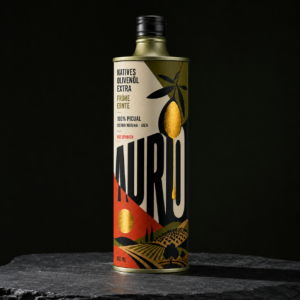
La Lata · 500 ml
100% Picual from a single grove in the Sierra Mágina, Jaén, at over 900 metres. Picked green in October and November, cold milled the same day below 27 °C, and packed in a 500 ml tin that keeps the light out completely.
If you want omega-3 from a cooking oil
Then olive oil is not where to look, and we would rather say so than pretend otherwise. Among common kitchen oils, rapeseed oil carries clearly more ALA, and linseed (flaxseed) oil more again. The marine omega-3s, EPA and DHA, come from fish and do not appear in any plant oil, olive oil included.
We make olive oil; we are not nutritionists, and we will not tell you what to eat. What we can say is why people reach for olive oil anyway:
- Flavour: green, bitter and peppery when the fruit is picked early.
- Stability: mostly single-double-bond fat, so it copes with heat and with storage.
- Traceability: an oil you can follow back to one grove and one day of milling.
Plenty of kitchens keep more than one oil for different jobs, which is a perfectly reasonable answer to the omega-3 question as well.