
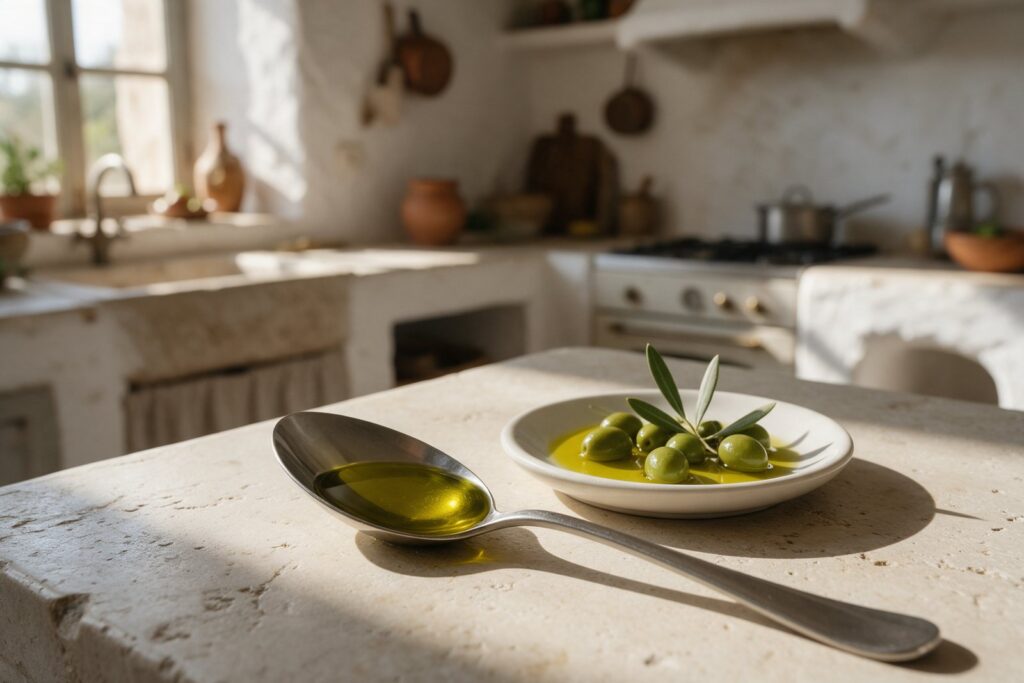
A tablespoon of olive oil is about 119–120 calories. The arithmetic is short: olive oil is 884 kcal per 100 g, which is 8.84 kcal per gram, and the conventional tablespoon is 13.5 g — 13.5 × 8.84 = 119.3 kcal. Every grade on the shelf gives you the same figure, because all of them are pure fat. Below: where the number comes from, how loose a spoon is, what the fat is made of, and whether an ingredient this calorie-dense is a fattening one.
How many calories in a tablespoon of olive oil
One figure sits behind all of this: the energy per 100 g. The rest is unit conversion. The three units people actually measure in:
- A teaspoon, ≈4.5 g: about 40 kcal.
- A tablespoon, ≈13.5 g: about 119–120 kcal.
- 100 g: 884 kcal, roughly 3 700 kJ.
The 884 kcal per 100 g is the USDA FoodData Central value, and it sits behind every spoon-sized number you will find. Asked as a total rather than per spoon — how many calories in olive oil — that is the answer, and it does not move between extra virgin, virgin and refined.
A label takes a second route to the same place. For nutrition labelling, Reg. (EU) 1169/2011, Annex XIV fixes the energy value of fat at 9 kcal (37 kJ) per gram, and olive oil is 100 g of fat per 100 g, so the label calculation for one spoon is 13.5 × 9 = 121.5 kcal. The two methods land about two kcal apart (121.5 − 119.3), which is roughly the precision this question can bear.
A tablespoon is not a standardised unit
13.5 g is a convention, not a measurement of your spoon — the value nutrition databases settle on so that a per-spoon figure can exist at all. The thing in your drawer is cutlery: a soup spoon and a dessert spoon differ, and a level spoon and a rounded one differ more.
So the honest form of the answer is about 120 kcal for a conventional 13.5 g spoon, and more than that if yours comes out generously filled. Quoting it to two decimal places invents precision the spoon does not have. If the number matters to you, put your own spoon on a kitchen scale once, read the grams and multiply by 8.84.
What is in the spoon: the fat profile
Olive oil is 100 g of fat per 100 g. No protein, no carbohydrate, no water of note — which is why energy is the only interesting number on the panel.
What varies is which fats. Trade standards set the ranges a genuine olive oil has to fall inside: oleic acid, which is monounsaturated, at 55.0–83.0 % of fatty acids; palmitic acid, saturated, at 7.5–20.0 %; linoleic acid, polyunsaturated, at 2.5–21.0 %; linolenic acid at no more than 1.0 % (Reg. (EEC) 2568/91, Annex I). They are wide because they cover every variety grown in the EU. A typical olive oil, rounded, comes out near 73 % monounsaturated, 14 % saturated and 11 % polyunsaturated.
Typical rounded profile, ≈73 % monounsaturated, ≈14 % saturated, ≈11 % polyunsaturated: USDA FoodData Central. Legal ranges under each bar — oleic 55.0–83.0 %, palmitic 7.5–20.0 %, linoleic 2.5–21.0 %, linolenic ≤1.0 % — Reg. (EEC) 2568/91, Annex I. Energy 884 kcal per 100 g: USDA FoodData Central. 9 kcal per gram of fat: Reg. (EU) 1169/2011, Annex XIV.
Picual, the variety we grow, sits at the high end of that oleic range. We have no measured figure of our own to quote, so we leave it there — it is the same chemistry behind how the oil tastes and how long it keeps.
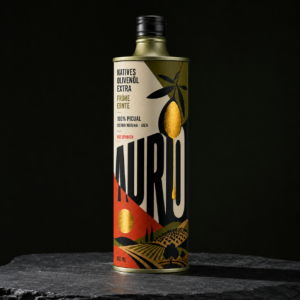
The tin · 500 ml
100 % Picual from one grove in the Sierra Mágina, in Jaén, at over 900 metres. Picked green across October and November and milled the same day, with extraction cold, below 27 °C. A 500 ml tin, because light is what destroys this kind of oil and metal blocks it completely.
What the profile does not change is the calorie count. Mono, saturated, polyunsaturated: all fat, all 9 kcal per gram for labelling. This is also why an oil sold as “light” or “extra light” carries exactly the same energy as any other — those words describe flavour and colour, and they are not among the EU grades. Those are in what extra virgin olive oil means.
Calorie-dense is not the same as fattening
Calorie-dense is just a description of the arithmetic above. Fat carries 9 kcal per gram, more than any other macronutrient, and olive oil is nothing but fat, so very little in a kitchen is denser in energy. That is a fact about the ingredient, and it is where our competence ends.
Fattening is a different kind of statement. It is about what a whole diet adds up to over weeks, how much oil you use and what else is on the plate — none of which a tin can tell you. We are a producer, not a dietitian, and the EU rules on nutrition and health claims exist precisely so that food companies stop answering questions like that one. What we can be exact about is quantity, because quantity is the part that happens in your kitchen:
- A measured spoon is countable; a free pour is not. One spoon is about 120 kcal, two are 2 × 120 = 240 kcal, and oil poured by eye in a stream is the one place people genuinely lose track. A measuring spoon is the whole solution.
- Frying is a different question from dressing. Food absorbs some of what it is cooked in, and how much depends on the food, the temperature and the time — the oil in the pan is not the oil you eat. The temperature side is in whether you can cook with extra virgin olive oil.
- Raw, you use less than you think. A teaspoon is ≈40 kcal, and a teaspoon of a strong oil does more on a plate of tomatoes than a tablespoon of a flat one.
What a spoon of it is actually used for
A nutrition database gives you the 884 kcal. What it cannot tell you is what a spoon of this oil does on a plate.
An early-harvest Picual is bitter and peppery and smells green — cut grass, green almond, tomato leaf. In a kitchen in Jaén a tablespoon of it is a finishing ingredient rather than a cooking medium: over toast in the morning, on sliced tomatoes with salt, stirred into gazpacho, a thread over white beans as the bowl reaches the table. The spoon is the seasoning, and you notice at once if you use two — a flavour limit rather than a calorie one. The fuller list is in how to use extra virgin olive oil.
Cooking is the opposite case. A pan holds far more than a tablespoon, much of it stays in the pan, and the aroma burns off early — which is why most houses here, ours included, keep two oils: an ordinary one for heat and volume, one good oil for the spoon at the end.
The oil we are measuring
How we make our oil does not shift the figure at the top of this page. Early harvest, same-day milling and a tin buy flavour and an oil that keeps; they do not buy a lighter spoon. A tablespoon of ours is the same ≈120 kcal as a tablespoon of the cheapest refined oil on the supermarket shelf, and anyone telling you otherwise is selling something.