
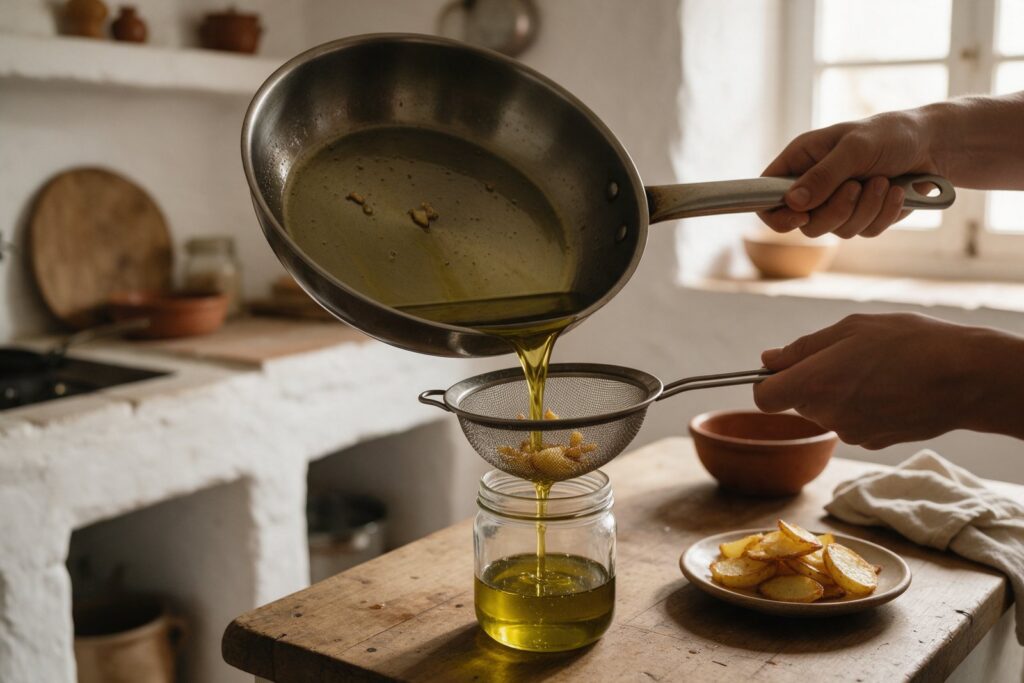
The honest answer to “how many times can you reuse olive oil for frying?” is that there is no fixed number. It depends on what went into the pan, how hot you ran it and how you looked after the oil afterwards. A pan of oil that fried clean chips at a steady heat and was strained straight away has several more uses in it than one that fried battered fish. The real answer is in the oil itself: once it smells off, foams, darkens, thickens or smokes earlier than it did the first time, it is finished, however many times you have used it.
How many times can you reuse olive oil for frying?
There is a rule of thumb that gets passed around kitchens, and it is worth knowing as long as you treat it as exactly that: a common kitchen rule, not a measurement and not a figure of ours. It goes roughly like this:
- Clean frying (potatoes, vegetables without coating): about three to four uses.
- Breaded or battered food, and fish: fewer, often one or two.
- Anything strongly flavoured (heavily spiced food, oily fish, cured meats): once, because the oil keeps the taste and passes it on to whatever you fry next.
The reason the range is so wide is that oil does not wear out by counting. Crumbs that fall off a coating burn and keep breaking the oil down long after the food is out. Salt and water from wet food speed up the reactions in the fat. A pan left on high heat while you answer the door can do more damage in a few minutes than a whole careful session. So use the rule to set your expectations, then let the oil tell you when it is done.
Five signs the oil is finished
Professional kitchens measure. In Spain, a 1989 order on heated oils and fats does not allow food businesses to keep using frying oil with more than 25 % polar compounds, and some kitchens check this with test strips. At home you approximate the same yardstick with your senses. Any one of these is enough to throw the oil out:
- The smell. Fresh oil smells clean, of olives at most. Tired oil smells stale, fishy, like old paint or like the last thing you fried, and you notice it as soon as it warms up.
- Foam that stays. A burst of bubbles when food goes in is normal; that is water turning to steam. A layer of fine foam that sits on the surface and does not settle is a sign the oil has broken down.
- Darkening. Every use darkens oil a little. When it has gone from gold to the colour of strong tea, or browns your food before it is cooked through, it is past it.
- Thickness. Used oil gets syrupy and leaves a sticky film on the pan and on the food, which comes out greasier rather than crisp.
- Smoke that comes earlier. If the oil starts smoking at a heat it handled quietly the first time, its smoke point has dropped and it will not recover.
What happens to the oil, fry after fry
Those signs are the visible end of three things happening in the pan at once. Water from the food splits fat molecules apart, which raises the free acidity with every use, one reason the smoke comes earlier. Oxygen at the hot surface attacks the fatty acids and produces the stale, painty smells. And with time and heat the broken pieces link up into larger molecules, which is what makes old oil thick, foamy and sticky. Together these products are what the polar compounds test measures.
Whether you may heat extra virgin olive oil in the first place, and what its smoke point really is, we covered separately in Can You Cook With Extra Virgin Olive Oil? The Real Numbers. Here the point is simpler: home frying sits at 170–180 °C, and going above about 190 °C speeds up all three processes, use after use.
Why a monounsaturated oil lasts more rounds
Oxidation needs a weak spot to start from, and in a fatty acid that weak spot is the double bond. Oleic acid, the main fat in olive oil, has one. Linoleic acid has two, and alpha-linolenic acid three, with the most reactive points sitting between them. The more double bonds in the pan, the more places for oxygen and heat to get in, and the faster the oil goes through the stages above.
That is where the oils differ. Under the Codex Alimentarius standards, olive oil is mostly oleic acid with relatively little linoleic, while regular sunflower oil is the reverse. Rapeseed sits in between and also carries some alpha-linolenic acid, which we compare in more detail in Rapeseed Oil vs Olive Oil: An Honest Comparison.
Oleic vs linoleic acid by oil (Codex ranges)
| Oil | Oleic acid (C18:1) | Linoleic acid (C18:2) |
|---|---|---|
| Olive oil | 55.0–83.0 % | 2.5–21.0 % |
| Sunflower oil | 14.0–39.4 % | 48.3–74.0 % |
| Rapeseed oil (low erucic) | 51.0–70.0 % | 15.0–30.0 % |
Extra virgin oil has a second line of defence. Its polyphenols are used up protecting the fat in the pan, which slows the oxidation for a while. They are spent along the way, so this helps most in the early rounds and does not make the oil last for ever. Picual, the variety we grow, naturally carries a lot of oleic acid and polyphenols as a cultivar, which makes it one of the more stable olive oils at the stove.
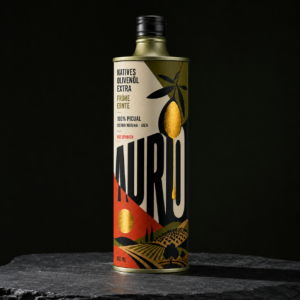
La Lata · 500 ml
100 % Picual from a single grove at over 900 metres in the Sierra Mágina, picked green early in the season and cold milled below 27 °C the same day. Packed in a tin, because light is the enemy of good oil and the tin keeps it out completely.
How to strain and store it between uses
Most of the life of a frying oil is decided after the frying is over. What we do at home:
- Let it cool, then strain it the same day. Warm, not hot. Pour it through a fine sieve lined with kitchen paper or a coffee filter. Every crumb you leave behind keeps burning next time.
- Use a clean, dry, closed container. Glass or metal with a tight lid, filled as full as possible so there is little air on top. Any water left in the jar speeds up the breakdown.
- Keep it dark and cool. A cupboard away from the hob, not the windowsill. Light and warmth keep working on used oil just as they do on fresh oil, which we explain in Does Olive Oil Go Off?
- Label it. Write what was fried in it and how many times. Oil that did fish stays oil for fish.
- Use it within a few weeks. Used oil has already started oxidising, so it keeps far less well than an unopened tin.
Never top up old oil with fresh and call it new. The fresh oil dilutes the signs without undoing the damage, and the mixture breaks down faster than the fresh oil would alone.
Habits that shorten its life
A few habits cost more uses than anything else:
- Salting food over the pan. Salt that falls into the oil is thought to speed up the breakdown, and it ends up in the crumbs at the bottom.
- Frying wet food. Pat it dry first; water is what splits the fat.
- Overcrowding the pan, which drops the temperature, so you turn the heat up and overshoot.
- Leaving the oil heating with nothing in it, or letting it smoke.
- Using a wide, shallow pan for deep frying. More surface means more contact with air.
Get those right, strain every time and trust your nose over any number. When the oil is done, let it cool and take it to your local collection point for used cooking oil rather than pouring it down the sink.