
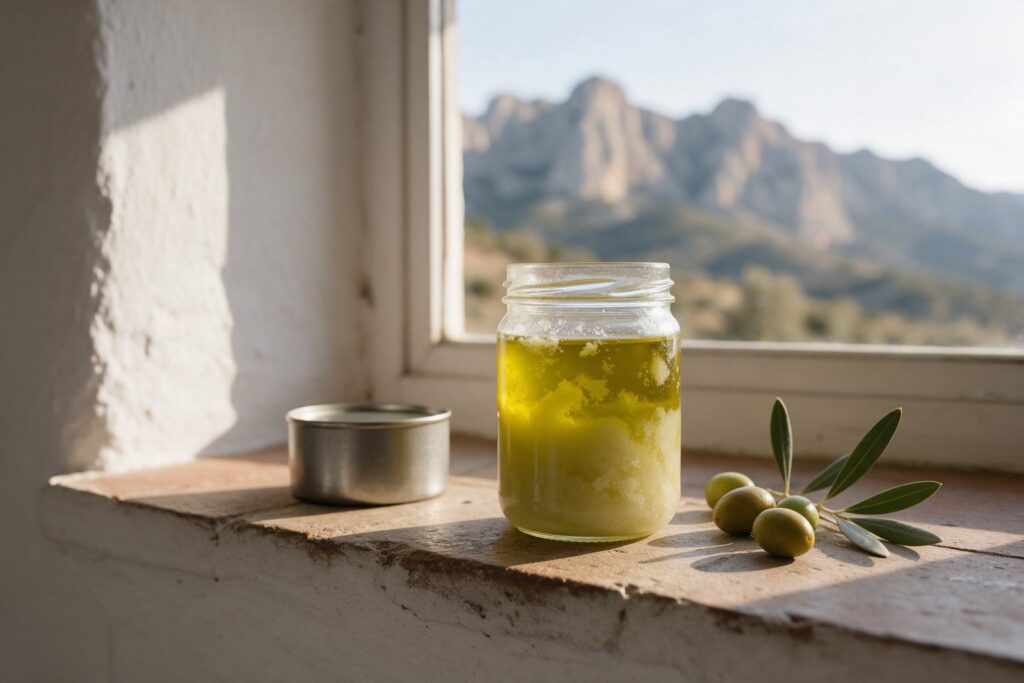
Yes, you can freeze olive oil. It won’t harm it: the oil turns cloudy, then thick, then sets solid, and once it is back at room temperature it clears and pours as before. The real question is whether you should, and for a bottle or tin you are using day to day the answer is almost always no. Here is what cold actually does to extra virgin olive oil, why it says nothing about quality, and the one case where the freezer earns its place.
Can you freeze olive oil?
Freezing is safe. Olive oil is a fat, not a water-based food, so there are no ice crystals tearing anything apart and nothing for bacteria to live on. In a home freezer at around −18 °C it sets into a pale, waxy block. Let it warm up and it becomes liquid again, with the same colour, the same smell and the same taste it had before.
So if you are asking “can you freeze oil” because you found a tin forgotten in a cold garage, or someone put the bottle in the freezer by mistake, relax. Nothing has been lost.
What freezing does not do is make the oil last longer in any way that matters in a normal kitchen. Oil kept well, away from light, heat and air, keeps its quality for a long time anyway. We cover how long in Does Olive Oil Go Off?. The freezer adds hassle without adding much.
What cold does to olive oil
Olive oil is not one substance. It is a mixture of different fats plus small amounts of natural waxes and other compounds that come from the fruit. Each of these sets at its own temperature, which is why olive oil does not freeze all at once the way water does.
As it cools, things happen in a rough order:
- First it clouds. The waxes and the more saturated part of the oil are the first to come out of solution. In a cold pantry in winter you may see a faint haze, or a few white specks drifting near the bottom.
- Then it flocks and thickens. After some hours in the fridge the haze becomes white flakes or soft clumps, and the oil pours slowly, like thin honey.
- Finally it sets. In the freezer the whole thing turns solid and opaque, closer to butter than to oil.
How quickly each stage arrives depends on the oil. Olive variety, how ripe the fruit was and how the oil was made all change the balance of fats, so two good oils can behave quite differently in the same fridge. That is the first clue that clouding is not a quality signal.
All of it is reversible. Warm the oil back to room temperature and the solid parts melt back in.
Cloudy from the cold, or cloudy from the mill?
Cold clouding is easy to confuse with a different kind of cloudiness. Some oils are sold unfiltered, and those carry tiny particles of fruit and water in suspension straight from the mill. That haze is there at any temperature and settles slowly to the bottom over the months. We explain it in Unfiltered Olive Oil: Why It’s Cloudy.
The quick way to tell them apart: cold clouding disappears when the oil warms up. If the oil is still hazy after a day at normal room temperature, you are looking at suspended fruit particles, not cold. Both are harmless; they just have different causes.
The fridge test is a myth
You will find the claim online that you can test whether an olive oil is real extra virgin by putting it in the fridge: if it goes solid it is genuine, if it stays liquid it is fake or blended. It does not work.
Whether and how fast an oil clouds in the fridge depends on its fat profile and wax content, which vary with olive variety, ripeness and processing. A perfectly genuine extra virgin can stay mostly liquid for a long time, and other oils can cloud too. The fridge cannot tell you the grade, the freshness or whether anything was blended in. Those are defined by lab analysis and by a tasting panel.
If you want to judge an oil yourself, use your nose and mouth: fresh green fruit, some bitterness, a peppery catch at the back of the throat, and no musty, vinegary or crayon-like notes.
Should olive oil go in the fridge?
Putting olive oil in the fridge will not damage it, but we don’t recommend it for the oil you cook with. There are three practical reasons:
- Condensation. Every time a cold container comes out into a warm kitchen, moisture forms on it and, if the cap is open, inside it. Water is not a friend of oil.
- Pouring. Thick, flaky oil does not pour. You end up leaving it on the counter to soften, which defeats the point of chilling it.
- Cycling. Going cold, warm, cold, warm day after day is more disruptive than keeping the oil at one steady, moderate temperature.
What actually protects olive oil is far simpler: keep it out of light, away from heat, and closed. A cupboard away from the hob and the oven is ideal. Light matters more than most people think, which is why the container counts. We compare the options in Tin vs Bottle.
Olive oil in the fridge does make sense in one situation: a very hot kitchen in high summer, with no cool cupboard anywhere. Then a few weeks in the fridge door is the lesser evil. Take out what you need for the day and let it come back to temperature.
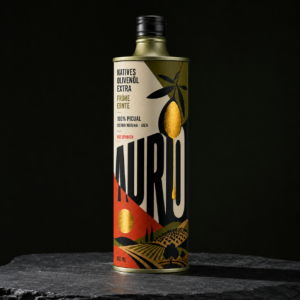
La Lata · 500 ml
Our oil is 100% Picual from a single grove at over 900 metres in the Sierra Mágina, Jaén. Picked green in October and November, cold extracted below 27 °C the same day. It comes in a 500 ml tin because light is the enemy of good oil, and the tin blocks it completely. A cupboard does the rest.
The one time freezing makes sense
There is one use for the freezer we do like: herb cubes. When you have more fresh herbs than you can use, chop them, pack them into an ice cube tray, cover them with olive oil and freeze. Once they are solid, tip the cubes into a freezer bag.
Rosemary, thyme and sage work well. Drop a cube straight into a hot pan to start a sauce, a stew or roast potatoes. The oil melts first and the herbs follow. You get small, ready portions.
Use the cubes within a few months, keep the bag well sealed so they don’t pick up freezer smells, and cook with them rather than thawing them for raw dressings.
How to bring cold oil back
If your oil has gone cloudy, thick or solid, the fix is patience:
- Leave the closed tin or bottle at room temperature. A few hours is usually enough for cloudiness; a frozen block takes longer.
- Don’t heat it on the hob or in the microwave. Gentle, slow warming is all it needs.
- If you are in a hurry, stand the closed container in a bowl of lukewarm water.
- Once clear, give it a gentle turn to mix back any last flakes, then store it in a cool, dark cupboard.
When it is liquid again, the oil is exactly what it was before. The cold left no mark on it.