
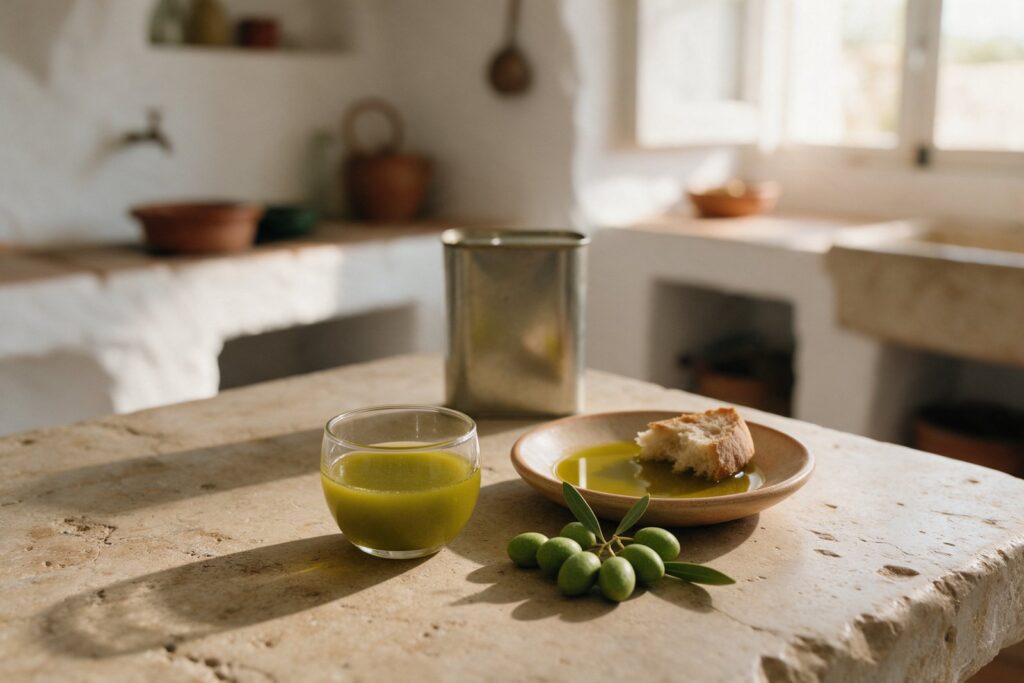
Ask which is the best olive oil and most answers hand you a ranking of brands. We will not: we are a small producer in Jaén selling one oil, so any list of ours would put ours on top and be worth exactly that much. What we can do is show you what we check when we judge an oil — on the label, then in a glass — so you can apply it to whatever is on the shelf, ours included.
Why there is no single best olive oil
Best depends on what the oil is for. A neutral refined oil is the sensible buy for deep-frying; it would be a waste on sliced tomatoes. And a green, peppery Picual and a soft, buttery Arbequina can both be faultless extra virgin oils that suit different plates and different people.
What does not depend on taste is condition: whether an oil is correctly graded, honestly sourced, recent and protected from light. Those are checkable. So the useful question is not which brand wins, but which bottle or tin in front of you passes.
Check the grade, and what acidity tells you
Start with the grade, because it is the only part of the label that is a legal test rather than a description. For anything you will eat raw, you want extra virgin. “Pure”, “light” and plain “olive oil” are refined blends; the full ladder is in what extra virgin olive oil actually means, so we will not repeat it here.
Extra virgin has two gates. The chemical one includes free acidity of no more than 0.8 %, a peroxide value of no more than 20 meq O₂/kg, and ultraviolet readings (K232 ≤ 2.50, K270 ≤ 0.22) that pick up oxidation. The second is a tasting panel: its median score for defects must be zero and its median for fruitiness must be above zero. An oil can pass the lab and fail the panel, and then it is only virgin.
Maximum free acidity, expressed as oleic acid: extra virgin ≤ 0.8 %; olive oil composed of refined and virgin olive oils ≤ 1.0 %; virgin ≤ 2.0 %; lampante above 2.0 %. Source: Reg. (EU) 1308/2013, Annex VII, Part VIII. Peroxide value ≤ 20 meq O₂/kg for both extra virgin and virgin: Reg. (EU) 2022/2104, Annex I.
Most labels do not print acidity, and that is fine: the grade already tells you it is under 0.8 %. Below the ceiling, a lower figure is no guarantee of a better oil. Acidity mostly reflects the state of the fruit at milling; it says little about how the oil has aged since, and nothing about how it tastes.
Find the harvest date
This is the most useful line on a label, and often it is missing. Olive oil is at its best young and fades from the day it is made. A best-before date is set by whoever packed the oil and does not tell you when the olives were picked. A harvest year does, and EU rules allow one to be printed only if all the oil in the container comes from that harvest.
So: look for a harvest year, and prefer the most recent one you can find. Where there is none, a best-before date a long way off at least suggests recent packing. If the label also says the fruit was picked early, that tells you about style as well as age — green fruit gives a sharper, more bitter oil, which we explain in early harvest olive oil.
Read the origin line
EU law requires the origin to be stated on extra virgin and virgin olive oil. Read it closely, because it ranges from very specific to almost meaningless:
- “Blend of EU oils” or “EU and non-EU oils” is legal and tells you only that oil from several places was mixed.
- A single country narrows it down.
- A region, a named variety and an estate or grove mean someone is willing to be held to a specific place and fruit. A protected designation of origin (PDO) seal adds a set of rules checked by a regulatory body.
More detail is not proof of quality, but it is accountability.
Look at the container
Light drives the oxidation that eventually turns olive oil rancid. Clear glass on a lit shelf is the worst case; dark glass is better but still lets some through; a tin blocks it entirely.
Size matters too: once opened, air does the same job more slowly, so buy what you will finish within a few months. The longer comparison is in tin versus bottle. This is the reason we pack the way we do.
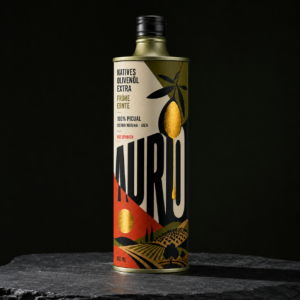
The tin · 500 ml
100 % Picual from a single grove in the Sierra Mágina, Jaén, at over 900 metres. Picked green in October and November, milled the same day, cold extracted below 27 °C. Packed in a 500 ml tin because the tin blocks light completely.
Taste it in a glass
The label gets you to a shortlist; the glass settles it. Pour a little into a small glass, warm it in your hand for a minute, then smell it and take a small sip, drawing air through it.
What you are looking for are the three positive attributes a tasting panel scores:
- Fruity — fresh olives on the nose: cut grass, green almond, tomato leaf in a green oil; softer notes in a ripe one.
- Bitter — on the tongue, especially in early-harvest oils.
- Pungent — a peppery catch in the throat, sometimes enough to make you cough. It comes from polyphenols and signals a fresh oil, not a fault.
Then check for defects. Crayons, putty or stale nuts mean rancid: the oil has oxidised. Fermented (fusty), mouldy (musty) or vinegary (winey) notes mean the fruit was in poor condition before milling. Any of these, and the oil should not be extra virgin, whatever the label says.
Feel counts too. A fresh oil feels clean and leaves the mouth quickly; a greasy, flat finish usually goes with age. Colour tells you very little, which is why professional tasters use coloured glasses.
The checklist, in one place
- Grade: extra virgin for anything eaten raw.
- Harvest year printed, and recent. If not, a distant best-before date.
- Origin as specific as you can find: region, variety, ideally grove.
- Container that blocks light — tin, opaque or dark glass — in a size you will use up.
- In the glass: fruit on the nose, some bitterness, some pepper, and none of the defects.
- Kept away from heat and light once it is home.
If an oil passes all six, it is a good olive oil. Which of the passing ones is the best is then a matter of what you cook and what you like.
How our own oil answers it
Here is our own oil against the same list. It is extra virgin, 100 % Picual, from a single grove in the Sierra Mágina, in Jaén, at over 900 metres. We pick early, in October and November, while the fruit is still green, mill it the same day, and extract it cold, below 27 °C. It goes into a 500 ml tin because light is the enemy of good oil.
Two honest gaps. We have no measured acidity or polyphenol figure of our own to print, so we do not print one; the grade is the claim we stand behind. And the taste is not for everyone: Picual is bitter and peppery, and if you prefer a mild oil, the checklist above will serve you better than our tin will.