
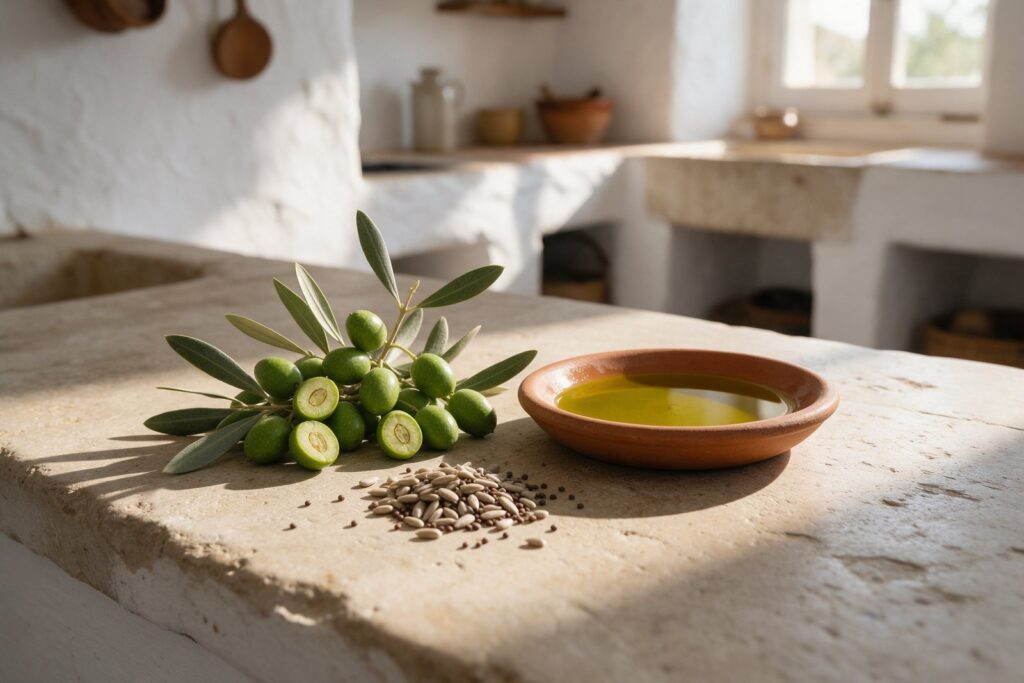
Is olive oil a seed oil? No. Olive oil comes from the fruit of the olive tree, the fleshy part around the stone, and the oil is separated from that flesh by mechanical means. Seed oils such as sunflower, rapeseed and soya come from seeds, and most of what you find on a supermarket shelf has been extracted with a solvent and then refined. That is the short answer. The longer one is more useful, because the word “olive” on a label does not tell you on its own which of those two routes the oil in the bottle took.
Contents
- Is olive oil a seed oil? The botanical answer
- How a fruit oil and a seed oil are made
- What is in them: the fatty-acid profile
- Where the line blurs: refined olive oil and pomace oil
- Why extra virgin, early harvest and cold extraction are the point
- Cold-pressed seed oils: not every seed oil is refined
Is olive oil a seed oil? The botanical answer
Botanically, an olive is a drupe, the same kind of fruit as a cherry or a plum: a thin skin, a fleshy pulp, and a hard stone with a small seed inside. The oil sits overwhelmingly in the pulp. The olive is crushed whole, stone and all, but it is the flesh that gives up the oil, which is why olive oil is classed as a fruit oil.
Seed oils are a different family. Sunflower, rapeseed (canola), soya, cottonseed and grapeseed oil all come from seeds, where the plant stores oil as a food reserve for the seedling. A seed is small, dry and hard; an olive is soft, wet and full of water. That physical difference shapes everything that follows.
How a fruit oil and a seed oil are made
Because the oil in an olive is already liquid and held in a wet paste, you can get it out by physical means alone. Olive oil was traditionally pressed from the fruit. Modern mills generally do it differently: the olives are washed and ground to a paste, the paste is stirred slowly for typically 20 to 45 minutes so the droplets of oil join up, and a horizontal decanter centrifuge then spins the oil away from the water and solids. Two-phase decanters are the norm in quality mills in Spain. There is no solvent and no chemical step. We mill our olives the same day they are picked and keep the paste below 27 °C, which is what “cold extraction” means under EU Regulation 29/2012. We go through each stage in how olive oil is made at our mill in Jaén.
Seeds do not give up their oil so easily. In industrial production they are cleaned, flaked and heated, and often pressed in an expeller first; the remaining oil (for soya, usually all of it, with no pressing step) is extracted with a solvent, normally hexane, which is evaporated off and recovered. The crude oil goes on to be refined: degummed, neutralised, bleached and deodorised, the last step using steam at high temperature to strip out smell and flavour. What comes out is clear, pale, neutral in taste and stable on the shelf. It is not a scandal, but it is a very different process from milling a fruit.
What is in them: the fatty-acid profile
Source and process aside, the oils also differ in what they are made of. Olive oil is mostly monounsaturated oleic acid. Conventional sunflower and soya oil are mostly polyunsaturated linoleic acid. Rapeseed sits in between, with a lot of oleic acid, a fair amount of linoleic acid and typically more linolenic acid than the others.
Ranges as % of total fatty acids. Linoleic acid: olive oil 2.5–21.0; sunflowerseed oil 48.3–74.0; rapeseed oil (low erucic) 15.0–30.0; soyabean oil 48.0–59.0. Oleic acid: olive oil 55.0–83.0; sunflowerseed oil 14.0–39.4; rapeseed oil 51.0–70.0; soyabean oil 17–30. Linolenic acid: olive oil ≤ 1.0; sunflowerseed oil ND–0.3; rapeseed oil 5.0–14.0; soyabean oil 4.5–11.0. Sources: olive oil, Reg. (EEC) 2568/91, Annex I; seed oils, Codex Standard for Named Vegetable Oils, CXS 210-1999, Table 1.
Two caveats keep this honest. The olive oil range is wide, because variety, ripeness and climate all move it. And plant breeders have developed high-oleic sunflower varieties whose oil falls well outside the conventional sunflower range shown here, closer to olive oil in its oleic content. The numbers describe composition. They do not, by themselves, rank one oil above another.
Where the line blurs: refined olive oil and pomace oil
Here is the part the seed-oil debate tends to skip. The olive industry has its own refined products. Virgin oil that does not meet the standard for sale, because of high acidity or a sensory defect, is sent to a refinery and treated much like a seed oil: neutralised, bleached, deodorised. The result is “refined olive oil”. Blend it with some virgin oil for colour and flavour and you get the bottle simply labelled “olive oil”, sometimes sold as “light” or “pure”.
Then there is olive-pomace oil. Pomace is what is left after milling: skins, pulp, stone fragments and water. A little oil remains in it, and pomace extractors recover it with a solvent, then refine it, and usually blend it with virgin oil. By process it has more in common with a refined seed oil than with extra virgin.
So for a shopper, the useful line is not really fruit versus seed. It is oil separated mechanically and left as it is, versus oil that has been solvent-extracted or refined. On the olive side, only virgin and extra virgin sit on the first side of that line. Extra virgin is the top grade: mechanical extraction only, free acidity of no more than 0.8 % as oleic acid, and no sensory defects. Our guide to what extra virgin olive oil is, grade by grade, sets out the rest.
Why extra virgin, early harvest and cold extraction are the point
If what draws you to olive oil is that it is a fruit oil, the thing to buy is the version that still tastes of the fruit. That means extra virgin, and ideally oil made with care at the two moments that decide its character: when the olives are picked and how quickly and gently they are milled. Green olives picked early in the season give less oil but a greener, more bitter and peppery one. Milling the same day prevents the fruit from fermenting in the meantime, and keeping the paste cool protects its aroma. We explain the trade-off in our early harvest olive oil guide.
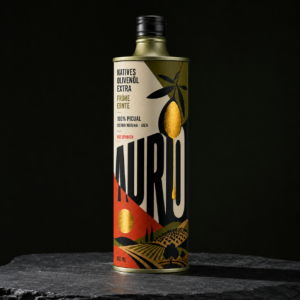
The tin · 500 ml
100 % Picual from a single grove in the Sierra Mágina, over 900 metres up. Picked green in October and November, cold milled the same day below 27 °C. Packed in a tin, because light is the enemy of good oil and the tin blocks it completely.
Cold-pressed seed oils: not every seed oil is refined
It would be unfair to leave the impression that every seed oil goes through a solvent and a refinery. Cold-pressed rapeseed, sunflower, linseed and pumpkin seed oils are pressed mechanically without added heat and sold unrefined. They keep their colour and flavour and sit in the same category of process as virgin olive oil, even though they come from a seed. “Seed oil” describes where an oil comes from, not one single way of making it.
We make olive oil, so we are not neutral about what we like to cook with. But the honest answer to the question is a botanical one, and it is clear: olive oil is a fruit oil, not a seed oil. Whether a particular bottle has been treated like one is a separate question, and the label answers it. Look for “extra virgin” first, then for a harvest season, a variety and a producer you can trace.