
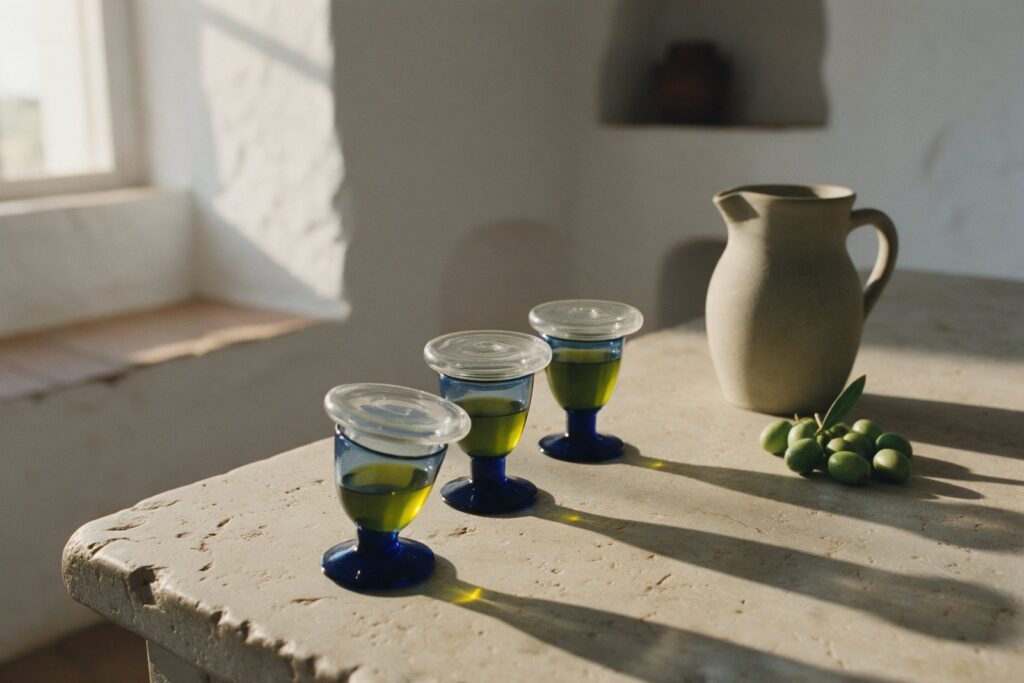
Extra virgin olive oil is not a compliment a producer pays itself. Under EU rules it is a legal grade, and a batch earns it only by passing two separate gates: a laboratory one and a human one. Most shoppers have heard of the first, free acidity of no more than 0.8% expressed as oleic acid. The second is the one that costs mills their grade, because it is the only point on the whole ladder where the answer has to be a flat zero.
Why extra virgin olive oil has to score a zero
The sensory assessment set out in Reg. (EEC) 2568/91 is done by an approved tasting panel: a panel leader plus eight to twelve trained tasters. They are not asked whether they like the oil. They score two things, the intensity of its defects and the intensity of its fruitiness. For the top grade the panel’s median defect score must be exactly 0, and the median fruitiness must be above 0.
That zero is the whole difference. Virgin olive oil, the grade immediately below, is allowed a median defect of up to 3.5 — a perceptible fault, formally tolerated. Extra virgin olive oil is allowed none at all. One detectable defect and the batch drops a tier, however good the chemistry is. An oil can come back from the lab well under the acidity ceiling and well inside the peroxide limit of 20 meq O₂/kg that both virgin grades share, and still be sold as virgin, because the panel’s median put a fault in it. Nothing about the word “extra” tells an English speaker that. It reads like a marketing intensifier, and it is the strictest clause in the regulation.
What disqualifies a batch
The panel works from a defined vocabulary of faults. Four account for most downgrades:
- Fusty. Fruit left in deep piles before milling, heating and fermenting in the heap.
- Musty. Mould and yeast on fruit held somewhere humid.
- Winey or vinegary. Fermentation gone further, into acetic acid.
- Rancid. Oxidation: age, warmth, light, air. The only one of the four a sound oil can develop after it leaves the mill, which is what an olive oil going off actually means.
Three of those four are settled before the fruit reaches the crusher. A mill cannot taste them out afterwards, and refining is the only process that removes them — which also removes the grade. That is why the clock between tree and crusher matters more than any machine in the building, and why we mill the same day we pick. The full sequence is in how olive oil is made, including what free acidity measures and what it does not.
The ladder, grade by grade
Extra virgin olive oil sits at the top of six grades defined in EU law. Only four of them may be sold to you in a shop.
| Grade | Max free acidity (% oleic acid) | Tasting panel | Sold at retail |
|---|---|---|---|
| Extra virgin olive oil | 0.80 | Median defect 0, median fruitiness above 0 | Yes |
| Virgin olive oil | 2.0 | Median defect up to 3.5, median fruitiness above 0 | Yes |
| Lampante virgin olive oil | above 2.0 | Median defect above 3.5 | No |
| Refined olive oil | 0.30 | Refined; not assessed by panel | No |
| Olive oil (refined and virgin olive oils) | 1.00 | Refined fraction; not assessed by panel | Yes |
| Olive pomace oil | 1.00 | Refined; not assessed by panel | Yes |
Lampante is the destination of fruit that arrived late, bruised or already fermenting. It is not sellable to the public as it stands. Nor is plain refined olive oil. Both are industrial inputs, and what they feed is the third retail grade.
The bottle that just says “olive oil”
That is the blend: refined olive oil, neutralised, bleached and deodorised, with enough virgin oil stirred back in to give it some colour and smell. Reg. (EU) 29/2012 makes the label say so, in the small type under the name — “oil comprising exclusively olive oils that have undergone refining and oils obtained directly from olives”. Nothing on the front of the bottle has to use the word refined. Extra virgin olive oil, by contrast, carries the line “superior category olive oil obtained directly from olives and solely by mechanical means”.
Refined oil is safe, legal and cheap, and it is cheap for a reason worth being straight about: refining strips the faults out, and with them the colour, the aroma and the polyphenols. What you are left with is a neutral fat with a high smoke point. For deep-frying three litres at a time, that is genuinely the sensible buy.
Olive pomace oil
Pomace — orujo in Spanish — is the solid residue left after the oil has been separated from the paste: skins, pulp, stone fragments, water. Oil is pulled out of that residue with solvent (hexane is the industry standard) and heat, then refined, then blended with some virgin olive oil so it can be sold. It is a legal, food-safe, inexpensive frying oil and Spanish professional kitchens use a great deal of it. It is also its own category, and it may not be labelled or sold as “olive oil”.
“Pure” and “light” are not grades
Two words an English-speaking shopper meets constantly appear nowhere in the regulation.
- Pure olive oil is, in practice, the refined-and-virgin blend wearing a better adjective. Look for the mandatory wording underneath; that is the grade.
- Light or extra light refers to flavour and colour, never to calories. It is a heavily refined blend with most of its taste removed. Every olive oil on the shelf is essentially pure fat, so every spoonful carries the same fat and the same calories whatever the grade. A “light” oil is lighter to taste and nothing else.
Asked plainly, then: what is extra virgin olive oil? It is the juice of sound fruit, separated by mechanical means alone, inside the acidity limit, that a trained panel could find no fault in at all. Everything else on the shelf is either the tier below it, or that juice after a refinery has been through it.
What extra virgin olive oil costs us
AURO is 100% Picual from a single grove in the Sierra Mágina, in Jaén, at over 900 metres. We pick early, across October and November, while the fruit is still green. The olives are milled the same day they are picked. Extraction is cold, below 27 °C — which is what “cold extraction” is legally permitted to mean under Reg. (EU) 29/2012 Art. 5: oil obtained below 27 °C by percolation or centrifugation. First cold pressing is the separate, older case of a hydraulic press; two-phase centrifugal decanters are the norm in Spanish quality mills today.
None of that buys a certificate. It buys the absence of the four defects above, and a panel decides whether we managed it, batch by batch. Keeping the result intact is the last step: we pack in a tin rather than a bottle, 500 ml, because light drives the oxidation that reads as rancid and metal blocks it completely. If you want to taste what the zero is for, it is the 500 ml tin of our Picual.