
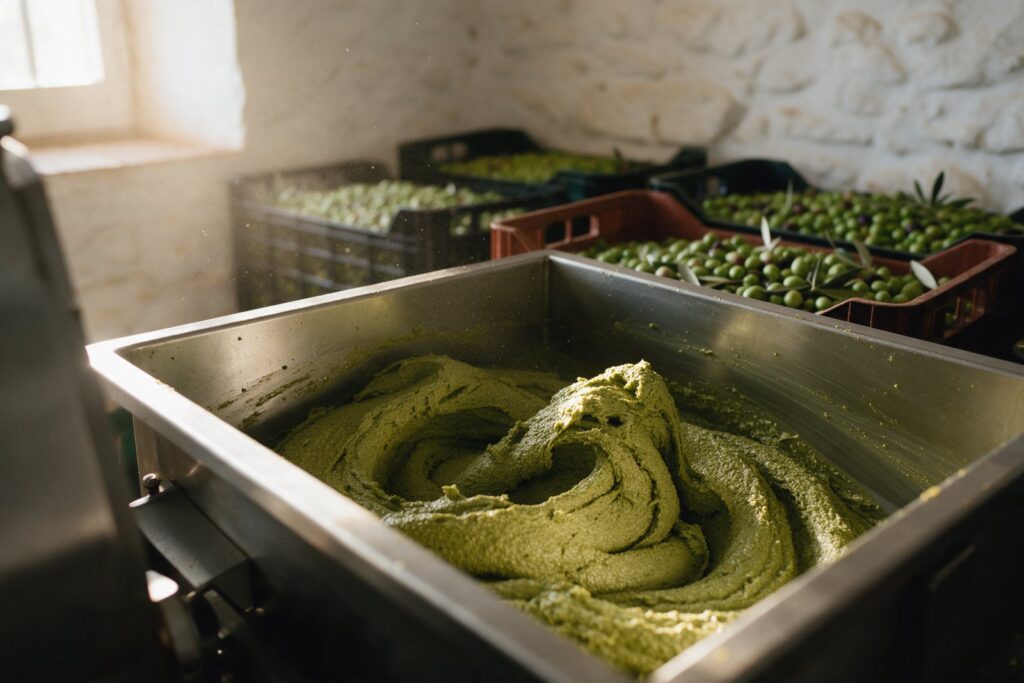
The short answer to how is olive oil made is that you crush whole fruit and spin the oil out of it. Nothing is added, and nothing is pulled out with heat or solvent. The long answer is where quality lives, because every step between the branch and the tin either protects the oil already inside the fruit or damages it. We grow and mill our own Picual in the Sierra Mágina, in Jaén, at over 900 metres, so this is the sequence as we run it.
If you came here searching how to make olive oil and wanted a kitchen method, this describes how a working mill does it. Extra virgin is a legal grade, established by chemical analysis and a tasting panel, and oil made at home cannot be graded or certified as one, so we have not written this as a recipe.
How is olive oil made? The sequence, start to finish
- Picking, in a chosen window of ripeness
- Transport to the mill, the same day
- De-leafing and washing
- Crushing in a hammer mill, stones and all
- Malaxation — slow stirring of the paste below 27 °C
- Separation in a horizontal centrifugal decanter, two-phase
- Polishing in a vertical centrifuge
- Storage in closed stainless steel tanks
- Filling
Nine steps, and no pressing in any of them. Stone presses have largely gone from Spanish mills; a modern mill is a continuous line of centrifuges. "Cold pressed" survives on labels as a habit of language, not a description of the machinery.
Picking: the window that decides the oil
We pick in the first weeks of the season, October and November, while the fruit is still green. Green fruit holds less oil and more of the compounds behind the taste of Picual — the bitterness, the pepper at the back of the throat, the cut-grass smell. As the fruit turns purple and then black, the yield per tonne climbs and that character fades. Why we choose the green end of that curve is set out in our guide to early harvest. Olives that have fallen and sat on the ground do not go in at all: they are already fermenting.
From tree to mill the same day
This is the step that decides more than any other, and the one no clever processing downstream can repair. An olive is a fruit. From the moment it leaves the branch, enzymes keep working, bruised flesh oxidises, and fruit stacked in deep piles heats up and ferments. Hours matter here, not days.
Our olives are milled the same day they are picked. A mill that takes delivery two or three days after picking cannot put back the aroma that has already gone, and the free acidity of whatever it makes will be climbing before the fruit even reaches the crusher. If you remember one thing about how the oil is made, make it the clock.
De-leafing and washing
At the mill the fruit crosses a blower that lifts out leaves and twigs. A little leaf is normal; too much pushes a stalky bitterness into the oil that did not come from the fruit. The olives are then washed: grit damages the crusher and soil leaves an earthy defect a taster finds at once. Everything else goes in whole — skin, flesh and stone.
Crushing: the hammer mill
A hammer mill is a rotor that throws the olives against a perforated steel screen until what passes through is a paste, stones included. The point is to tear open the cells of the flesh so the oil droplets inside them are free to come together. Hammer mills are fast and violent, which is part of why they tend to give an oil richer in phenolic compounds than gentler crushers. They also generate heat, so the next step is temperature-controlled.
Malaxation: the slow stir where oil is won or lost
The paste moves into a malaxer, a jacketed trough with slow-turning blades, and is stirred there for 20 to 45 minutes. The purpose is coalescence: tiny oil droplets scattered through the paste merge into larger ones a centrifuge can separate. Without it, much of the oil stays locked in the paste.
Malaxation is also the honest trade-off of the whole process. Stir longer and warmer and you get more oil out of the same fruit; you also expose the paste to oxygen for longer and lose volatile aromas and part of the phenolic content to the heat. "Cold extraction" is not a marketing phrase but a legally defined term, requiring the process to run below 27 °C. We hold ours below that, and it is the most expensive decision taken in the mill, because it is paid for in litres.
Decanter and vertical centrifuge
The paste is pumped into a horizontal centrifugal decanter, a spinning drum that separates it by density into oil and wet pomace. Two-phase decanters are the norm in Spain: they add no water, so water-soluble phenols are not washed out of the oil, and they leave one wet pomace stream instead of a separate flow of waste water.
The oil then passes through a vertical centrifuge, which spins out the last of the vegetation water and the fine solids suspended in it. What comes off that machine is olive juice: cloudy, green, unfiltered, minutes old. Across the industry a tonne of olives gives roughly 15 to 20 per cent of its weight as oil, depending on variety, ripeness and how the mill is run.
Storage in stainless steel, then filling
The oil is settled and held in closed stainless steel tanks, kept cool and dark and filled as full as possible so there is little headspace and little oxygen. Settling matters: fine solids left in suspension ferment and give the oil a muddy, winey edge. Oxygen, light, heat and time degrade an olive oil; the tanks keep all four away from it.
Filling is the last chance to undo the work. We pack in a tin rather than a bottle, a 500 ml format, because light is the enemy of good oil and metal blocks it completely. If you want to taste what the sequence above produces, it is the 500 ml tin of our Picual.
What free acidity actually measures
Free acidity is the figure quoted most often and understood least. It measures the free fatty acids in the oil, expressed as a percentage of oleic acid. To be sold as extra virgin in the EU, an oil must have a free acidity of no more than 0.8 per cent.
- It is a measure of fruit and handling quality, not of flavour. You will not taste 0.2 against 0.5.
- It rises when fruit is bruised, fermenting or left too long before milling: enzymes break the triglycerides apart and release fatty acids.
- It has nothing to do with how hard anything was pressed. Pressing is not part of a modern mill at all.
- A low figure is evidence of sound fruit milled fast, and it belongs to one batch rather than to a producer, which is why we quote no number here. On its own it does not make a good oil either: the sensory panel has to pass too.
The other route: refined oil
It is worth knowing what happens to fruit that misses the window. Olives that arrive late, bruised or fermented give a defective oil: too high in acidity, or carrying faults a tasting panel will reject. It cannot be sold as virgin, so it goes to a refinery to be neutralised, bleached and deodorised. That strips out the defects, and with them the colour, the aroma and most of the polyphenols. What is left is blended with a little virgin oil and sold as plain "olive oil". None of that is unsafe, and it is why cheap olive oil is cheap.
Where the quality is really decided
Variety, altitude and soil set the range an oil can occupy. The mill decides where inside that range it lands, and the largest lever there is the clock between tree and crusher. Pick early, mill the same day, hold the paste below 27 °C, accept the litres you lose. The rest is engineering.